Associação Portuguesa de Enfermeiros de Anestesia, Reanimação e Terapêutica da Dor 06/06/07
Developmental Milestones: Comparison of Various Ages
Obter link
Facebook
X
Pinterest
Email
Outras aplicações
-
Milestones of various ages provide a predictable pattern in infants and children concerning the development of their skills in each age group. Understanding of the normal child development helps clinicians to identify any symptom of delayed child development. Early identification of the developmental delays can prevent future complications, and the child can be timely referred for therapeutic services. The aim is to promote healthy development. Developmental milestones have been established in physical, social, verbal and cognitive domains.
Height increases at a peak rate of 10 centimeters per year.
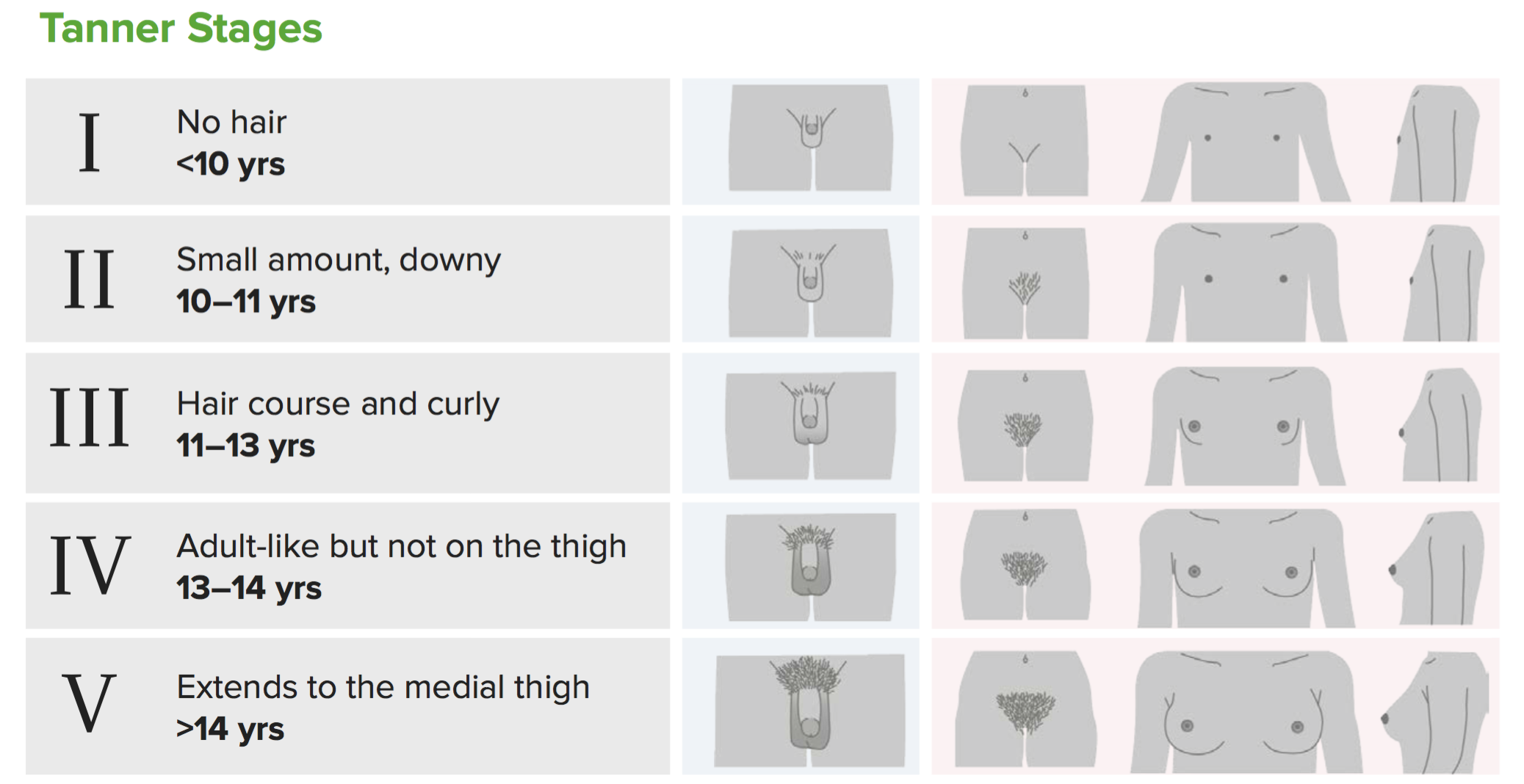
Pubic hair of adult quality.
Pubic hair does not spread to the junction of medial thigh with perineum.
Average age is 13.9 years.
Continued growth of penis in length and width.
Length of testes is 4.1 to 4.5 cm.
Axillary hair is present at 14 years of age.
Voice changes (age 14.1 years).
Appearance of teenage acne.
Tanner 5:
No increase in height after 17 years of age.
Adult pubic hair distribution (15.3 years).
Pubic hair spreads to the medial thigh.
Pubic hair does not spread to linea alba.
Mature genital size by 16.5 years of age.
Length of testes is greater than 4.5 cm.
The appearance of secondary sexual characteristics like facial hair, male physique, the disappearance of gynecomastia.
Stages of Development According to Erik Erikson
Erik Erikson has proposed an eight stages of development that each person must goes through until maturity. This concept is more based on our understanding of psychology and social skills. The following table summarizes the stages of development according to Erik Erikson:
Age
Developmental Task
Birth to 1 year
Infants usually go into a struggle to whether they should trust or mistrust others. Babies are dependent on others for their basic needs such as nourishment and warmth. The normal developmental milestone by the age of 1 year according to this classification is to trust the care-giver.
1 to 3 years
The purpose of the different developmental milestones that the child gain by the age of 3 years is to realize autonomy. Therefore, the child will learn to be either self-sufficient in most of the daily activities or the child might develop shame and doubt according to Erik Erikson.
3 to 6 years
The developmental milestones gained by the age of 6 years make the child more independent from his or her parents. Accordingly, the child might show initiative or feel guilt if he or she does not follow the parents’ rules.
7 to 11 years
This is a very important developmental milestone according to Erik Erikson. By this age, the child can be either productive and competent, or can develop an inferiority complex. If the later happens, the child might eventually become unable to be a productive member of the society. This age was called middle childhood per Erik Erikson’s classification.
Adolescence
Most of the milestones gained in adolescence serve to answer the big question “Who am I?”. Therefore, adolescents will establish their sexual, ethnic, and career identities. If an adolescent fails in this developmental milestone, he or she will fail to see their future role.
Young Adulthood
Young adults need to be either intimate with others and develop meaningful relationships or become isolated. Therefore, young adults will usually seek companionship and love.
Adulthood
Middle-aged adults are expected to be productive and to perform meaningful work. They are also expected to raise a family. Failing in this milestone would result in stagnation and being inactive.
Mature Adult
Older adults are expected to make sense of their lives and to see life as meaningful. If they fail in doing so, they will go into despair. Therefore, the normal final developmental milestone according to Erik Erikson is to achieve integrity.
Therefore, Erik Erikson’s point of view on developmental milestones is that they are tools we acquire to resolve certain conflicts that are specific to each milestone. Failing to resolve such a conflict would result in abnormal development. Erik Erikson’s classification covers all the life-span of the person and not only childhood and adolescence.
Hemorrhoids cushions are normal structures of the lower rectum. They are very vascular and pathology develops when that vasculature becomes engorged (especially the veins). Itching and pain are common symptoms of hemorrhoid pathology. Hemorrhoids are classified on their origin relative to the dentate line: external (below the dentate line), internal (above the dentate line), and prolapsed internal hemorrhoids. Most hemorrhoids are treated with dietary modification (increase fiber) and stool softeners, but occasionally surgery is required. Table of Contents Definition of Hemorrhoids Epidemiology of Hemorrhoids Etiology of Hemorrhoids Pathology and Pathophysiology of Hemorrhoids Symptoms of Hemorrhoids Diagnosis of Hemorrhoids Differential Diagnoses of Hemorrhoids Therapy of Hemorrhoids Progression and Prognosis of Hemorrhoids Review Questions References Image : “Types of hemorrhoids” by WikipedianProlific and Mikae...
In Lecturio ;) - In rheumatology, we talk mainly about disorders of the musculoskeletal system, connective tissue diseases, inflammatory disorders, and bone disease. Musculoskeletal pain is a common feature in most rheumatological disorders and might be caused by arthritis or soft tissue inflammation. In this article, you will get an introduction to rheumatology and pseudogout and gain all essential information for your next medical exam. Table of Contents An Introduction to Rheumatology Clinical Evaluation in Rheumatology Common Rheumatological Disorders Gout Management of Gout Complications of gout Pseudogout: Calcium pyrophosphate dihydrate crystal deposition disease Treatment of Pseudogout References Image : “Bursitis Elbow” by User:NJC123. License: Pubilc Domain> An Introduction to Rheumatology Rheumatology is the branch of medicine associated with evaluation and treatment of people have disorders of muscles and joints i...
In Lecturio ;) Colorectal cancer originates from the colon and rectum in the body. It is a very common type of cancer in the United States. The molecular pathogenesis of colorectal cancer involves complex pathways. There are different types of colonic polyps associated with colorectal cancer; mostly are precancerous in nature. In this article, different pathological mechanisms, colonic polyps, symptoms, diagnostic tests, treatment and prognosis of colorectal cancer will be discussed in detail. Table of Contents Definition of Colon Cancer Overview of Colon Cancer Epidemiology of Colon Cancer Pathology and Pathophysiology of Colon Cancer Colonic Polyps and Colorectal Cancer Symptoms of Colon Cancer Diagnosis and Laboratory Tests of Colon Cancer Treatment of Colon Cancer Prognosis of Colon Cancer Review Questions References Image : “Gross pathology of villous adenoma” by Ed Uthman . License: Public Domain Defi...



i have nice artical read How To Reduce Belly fat.
ResponderEliminarReduce Belly fat